
InventSim introduces an advanced shape deformation framework that enables intuitive and highly efficient geometry manipulation of 3D electromagnetic models.
Instead of relying solely on traditional geometric parameters defined via constructive solid geometry (such as lengths, radii, or coupling gaps), InventSim enables continuous deformation of the entire electromagnetic structure using a controlled mathematical mapping. This approach significantly expands the available design space, making it possible to discover high-performance solutions that are difficult or impossible to achieve with conventional parametric methods. Examples include global bending, twisting, and localized structural deformations of the geometry.
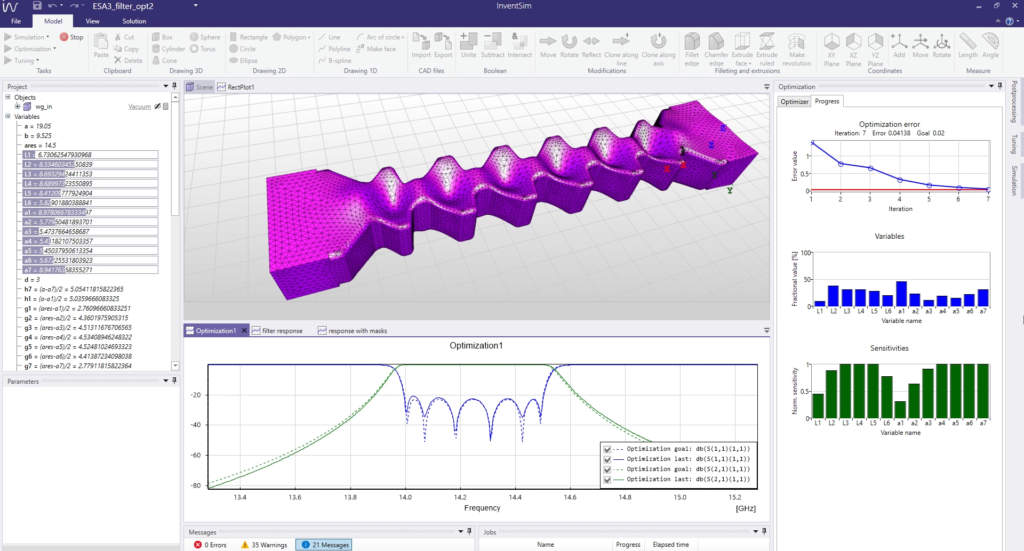
Radial Basis Function (RBF) Deformation Engine
At the core of the method lies Radial Basis Function (RBF) interpolation, which defines a smooth and globally consistent deformation field. The geometry is controlled through a set of user-defined control points, whose displacements generate a continuous transformation of the entire 3D model.
Key characteristics of the method include:
- smooth, mesh-consistent deformation of complex 3D structures
- preservation of geometric continuity and manufacturability
- local or global control depending on control point placement
- compatibility with arbitrary CAD and FEM discretizations
This enables deformation of cavity resonators, waveguide filters, and other microwave components without remeshing or manual geometry reconstruction.
Coupling with Full-Wave FEM Simulation
The deformation engine is tightly integrated with a 3D finite-element electromagnetic solver, enabling fully automated design optimization workflows. During optimization, both:
- classical geometric parameters, and
- deformation control variables
are adjusted simultaneously.
This dual-level parameterization provides significantly increased degrees of freedom, allowing the solver to explore non-intuitive geometries that improve key RF performance metrics such as:
- suppression of spurious modes
- filter selectivity and transmission zero placement
- out-of-band rejection performance
Design Methodology and Engineering Impact
The deformation-based workflow originates from research demonstrating that geometry flexibility is a powerful design variable in microwave engineering, particularly when combined with additive manufacturing technologies. By enabling smooth, manufacturable shape transformations, the method bridges the gap between electromagnetic optimization and real-world fabrication constraints.
In practical terms, shape deformation allows engineers to:
- replace discrete tuning elements with continuous geometry shaping
- design dual-mode and high-order cavity filters with improved modal control
- achieve higher performance in compact 3D-printed structures
- reduce reliance on manual tuning and heuristic geometry adjustments
Advantages Over Traditional CAD-Based Optimization
Compared to conventional parametric optimization, RBF-based shape deformation offers:
- Higher design freedom without increasing CAD complexity
- Better exploration capability of non-standard geometries
- Compatibility with additive manufacturing constraints
This makes it particularly well-suited for next-generation microwave components designed for 3D printing and high-frequency applications.